
Divyesh M.
Author
AI Agents in 2026: The Future of Intelligent Automation (Complete Guide)
A complete guide to how AI agents work, where they are being used, how businesses can implement them effectively, and what risks and opportunities lie ahead.
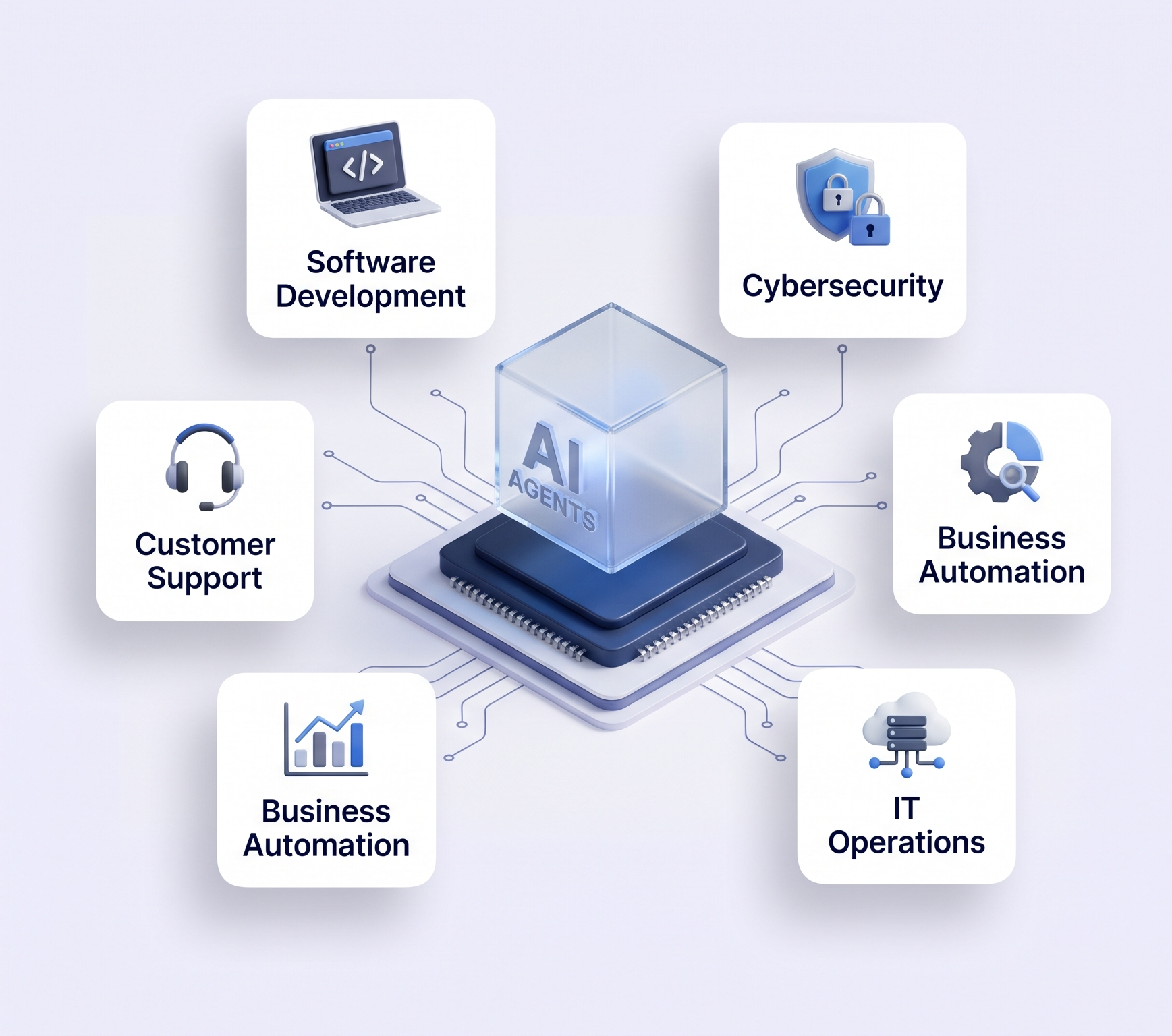
AI is transforming the way businesses operate — from automating repetitive tasks to making smarter decisions. Discover how AI agents are changing software development, business operations, and the future of technology.
Artificial Intelligence has evolved beyond simple chatbots and content generators. In 2026, AI agents are becoming capable of understanding goals, planning tasks, interacting with applications, and completing complex workflows with minimal human intervention.
01. Understand What AI Agents Are
AI agents are intelligent systems designed to perform tasks independently by understanding instructions, analyzing information, and making decisions.
Unlike traditional AI tools that provide answers to individual questions, AI agents can work through multiple steps to achieve a specific goal.
Key characteristics of AI agents:
- Understand user instructions and objectives
- Break complex tasks into smaller steps
- Access external tools and applications
- Analyze information and make decisions
- Learn from feedback and improve their approach
- Complete workflows with minimal human intervention
For example, instead of asking an AI to write an email, you could ask an AI agent to research a company, draft a personalized email, organize your contact list, and prepare a follow-up workflow.
The goal is to move from AI that simply responds to AI that actively helps complete work.
02. Explore How AI Agents Work
AI agents operate through a combination of artificial intelligence models, memory, tools, and decision-making systems.
The process generally includes:
- Receive a goal or instruction from the user
- Analyze the task and determine what needs to be done
- Create a step-by-step execution plan
- Select the appropriate tools and resources
- Execute actions and collect information
- Evaluate the results and adjust the approach
- Deliver the completed task or report
For example, an AI agent building a website might research the target audience, generate a layout, write code, test the functionality, identify errors, and improve the final result.
This ability to combine reasoning with action is what makes AI agents different from traditional AI applications.
03. Discover the Most Important Applications
AI agents are being introduced across multiple industries, helping businesses improve efficiency and reduce repetitive workloads.
Software Development
- Generate and review code
- Identify bugs and security vulnerabilities
- Write automated tests
Customer Support
- Answer customer questions
- Analyze support requests
- Categorize tickets
Business Operations
- Automate repetitive workflows
- Generate reports and insights
- Process information across applications
AI agents can help organizations automate processes that previously required multiple applications and manual intervention.
04. Implement AI Agents Into Your Workflow
Businesses don’t need to completely redesign their operations to start using AI agents. The best approach is to begin with simple, repetitive tasks.
A practical implementation process:
- Identify repetitive tasks that consume valuable time
- Choose a suitable AI agent platform
- Define clear objectives and limitations
- Connect the required tools and data sources
- Test the agent using real-world scenarios
- Monitor performance and improve the workflow
Start with low-risk tasks such as generating reports, organizing information, or answering common support questions.
Once the system becomes reliable, businesses can gradually introduce more complex workflows.
The key is to implement AI where it creates measurable value rather than adopting it simply because it is trending.
05. Understand the Challenges and Risks
While AI agents offer significant advantages, they also introduce new challenges that organizations must consider.
Important considerations include:
- AI-generated information may be inaccurate
- Sensitive data requires proper protection
- Agents may require access to important systems
- Automated decisions can produce unexpected outcomes
- AI workflows may increase infrastructure costs
- Human supervision is necessary for critical tasks
Organizations should establish clear permissions, security policies, testing procedures, and monitoring systems before deploying AI agents.
A well-designed AI workflow should always include appropriate safeguards and a way for humans to intervene when necessary.
06. Prepare for the Future of AI Agents
AI agents are expected to become more integrated into everyday software and business systems.
In the future, organizations may use multiple specialized AI agents working together to complete complex tasks.
Emerging possibilities include:
- AI-powered software development teams
- Autonomous business workflow management
- Automated data analysis and reporting
- AI-powered customer experiences
For IT professionals, learning how AI agents work, understanding automation tools, and developing AI integration skills may become increasingly valuable.
The future will likely involve collaboration between human professionals and intelligent systems rather than complete automation of every role.
Final Thoughts
AI agents are helping businesses save time, automate daily tasks, and make work easier. But the real value comes from using AI responsibly while keeping human ideas and decisions at the centre. The future of IT is about bringing people and technology together to work smarter.
Recent Articles



Bhargav V.
Author
Magento 2 Security Patches: Complete Guide to Protecting Your Magento Store
Learn what Magento 2 security patches are, why they matter, and how to safely identify, test, and apply them, covering vulnerabilities, Composer patches, Cloud deployments, and post-patch verification.