

Devansh G.
Author
AI-Native Development & Infrastructure: Building Software for the AI-First Era
A practical look at AI-native development and infrastructure, covering AI-powered development workflows, agent-based application architecture, AI-ready cloud platforms, intelligent DevOps and MLOps, AI security and governance, and continuous innovation.
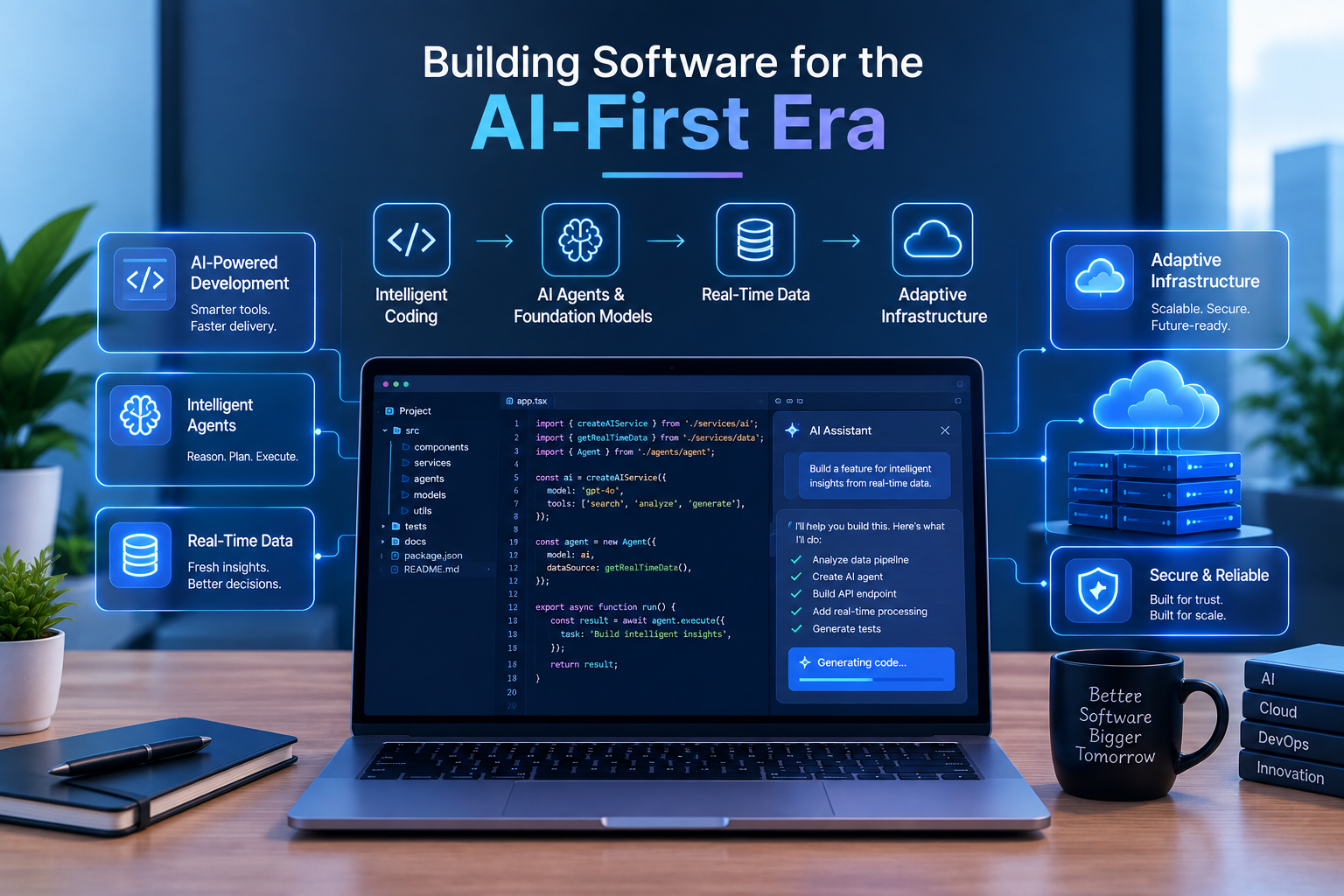
Discover how AI-native development is transforming the way businesses design, build, deploy, and scale modern software, from intelligent coding workflows to AI-ready infrastructure.
Discover how AI-native development is transforming the way businesses design, build, deploy, and scale modern software. From intelligent coding workflows to AI-ready infrastructure, organizations are adopting new approaches to improve speed, efficiency, and innovation.
As AI becomes embedded across the software lifecycle, development teams are moving beyond traditional automation toward systems designed around intelligent agents, foundation models, real-time data, and adaptive infrastructure. This shift is creating a new generation of scalable, AI-first applications.
01. AI-Powered Development
AI is becoming an active part of the software development lifecycle, helping teams move from ideas to production faster.
- AI-assisted coding and code generation
- Automated testing and debugging
- Intelligent code reviews
- Documentation generation
- Developer productivity optimization
AI-native development allows engineers to focus more on architecture, creativity, and complex problem-solving while repetitive development tasks are increasingly automated.
02. AI-Native Application Architecture
Modern applications are being redesigned around AI capabilities rather than simply adding AI as an extra feature.
- Agent-based application design
- Model-integrated workflows
- AI-powered personalization
- Real-time decision systems
- Human-AI collaboration
Organizations are building applications that can understand context, reason over data, and continuously improve user experiences.
03. AI-Ready Cloud Infrastructure
AI workloads require infrastructure capable of handling large-scale computation, data processing, and model deployment.
- GPU and accelerated computing
- Scalable cloud architecture
- AI workload orchestration
- High-performance data pipelines
- Elastic infrastructure
AI-ready infrastructure enables businesses to deploy intelligent applications efficiently while maintaining scalability, reliability, and performance.
04. Intelligent DevOps & MLOps
Development and operations are becoming increasingly intelligent as AI enters monitoring, deployment, and infrastructure management.
- AI-assisted observability
- Predictive infrastructure monitoring
- Automated deployment optimization
- Intelligent incident detection
- Model lifecycle management
Combining DevOps with AI-driven automation helps teams reduce operational complexity and respond to issues faster.
05. AI Security & Governance
As organizations deploy AI at scale, security, privacy, and governance are becoming essential components of AI-native infrastructure.
- Model security and access controls
- Data privacy protection
- AI risk monitoring
- Secure API and agent access
- Responsible AI governance
Building security into AI systems from the beginning helps organizations protect sensitive data while maintaining trust and regulatory readiness.
06. Continuous AI Innovation
AI-native development is not a one-time transformation. It requires organizations to continuously experiment, learn, and improve.
- Continuous model evaluation
- AI performance optimization
- Emerging model adoption
- Developer upskilling
- Experimentation and rapid iteration
Businesses that establish a culture of continuous AI innovation can adapt faster as models, tools, infrastructure, and development practices evolve.
Final Thoughts
AI-native development is reshaping the future of software engineering and infrastructure. It combines intelligent development tools, AI-first architecture, scalable infrastructure, automation, and strong governance to create faster and more adaptive technology environments.
Organizations that build AI into their development processes and infrastructure today can create a stronger foundation for the next generation of digital products and services.
Recent Articles


Bhargav V.
Author
Magento 2 Security Patches: Complete Guide to Protecting Your Magento Store
Learn what Magento 2 security patches are, why they matter, and how to safely identify, test, and apply them, covering vulnerabilities, Composer patches, Cloud deployments, and post-patch verification.

Devansh G.
Author
Why User Experience Is Critical to Digital Product Success in 2026
Discover why strong UX is essential for successful digital products and how thoughtful design improves navigation, accessibility, mobile usability, conversions, engagement, and overall customer satisfaction.


Devangi M.
Author
How Strong Technology Partnerships Help Businesses Scale Faster
Discover how the right technology partner can accelerate growth through specialized expertise, faster delivery, long-term planning, continuous improvement, clear accountability, and reliable technical support.