
Gaurang P.
Author
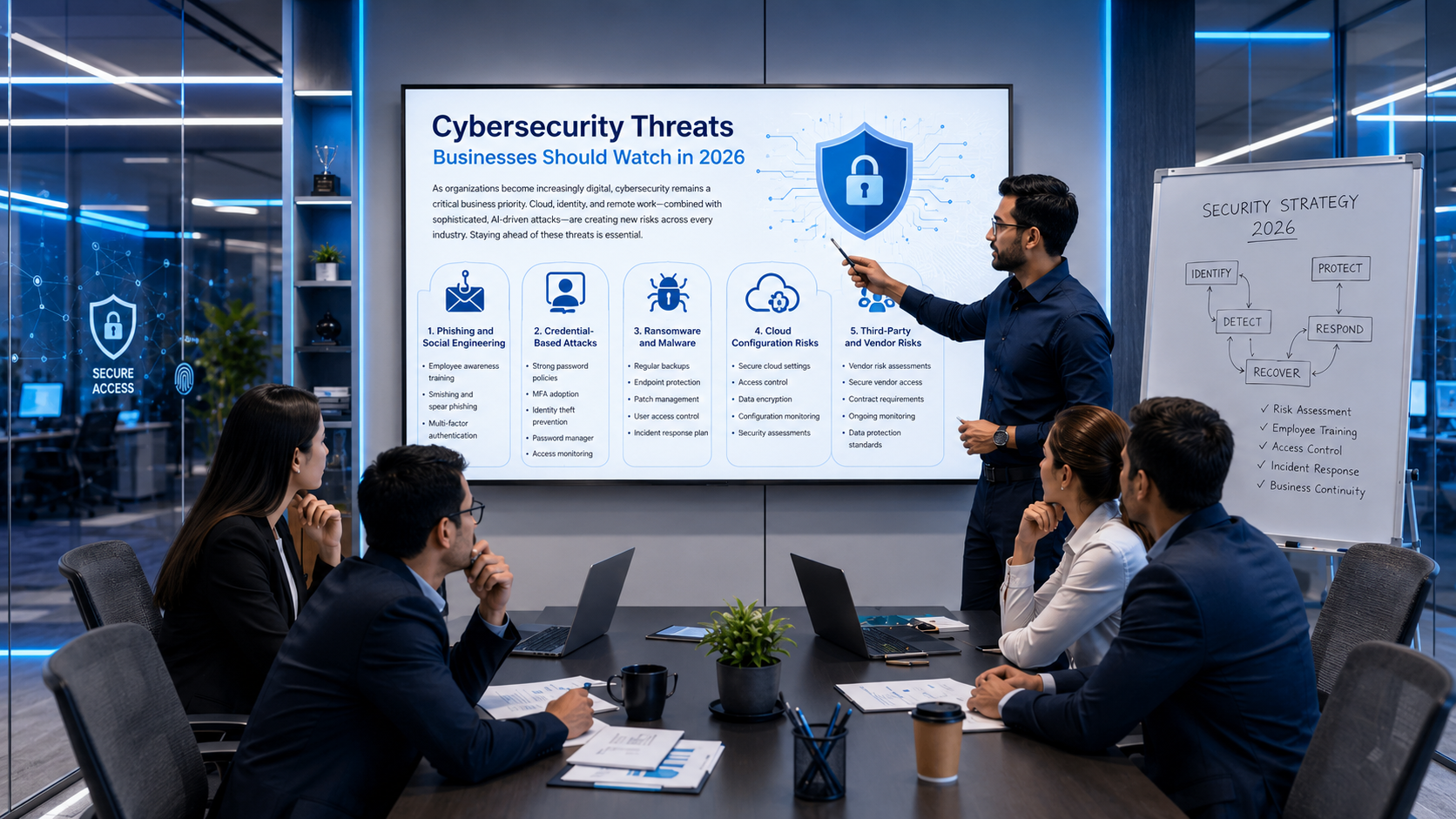
Cybersecurity Threats Businesses Should Watch in 2026
Learn about the cybersecurity threats businesses should watch in 2026, including phishing, credential attacks, ransomware, cloud configuration risks, and third-party security challenges.
Discover the key cybersecurity risks businesses face in 2026 and the practical security measures that can help protect accounts, cloud systems, data, operations, and third-party integrations.
As organizations become increasingly digital, cybersecurity remains a critical business priority. Cloud services, remote work, connected applications, and AI tools provide valuable opportunities but can also expand the potential attack surface.
Businesses need to understand emerging risks and maintain strong security practices.
Phishing and Social Engineering
Attackers continue to use deceptive messages to encourage employees to reveal sensitive information. Businesses can reduce risk through:
- Employee awareness training
- Email security controls
- Multi-factor authentication
- Verification processes
Employees remain an important part of an organization's security strategy.
Credential-Based Attacks
Compromised passwords can provide attackers with access to business systems. Organizations should implement:
- Strong authentication policies
- Multi-factor authentication
- Password management tools
- Access monitoring
Identity security is increasingly important in cloud-based environments.
Ransomware
Ransomware can disrupt operations by encrypting or restricting access to important data. Businesses should focus on:
- Secure backups
- System updates
- Endpoint protection
- Network monitoring
- Incident response planning
Preparation can reduce the impact of a security incident.
Cloud Configuration Risks
Cloud environments can introduce security issues when systems are configured incorrectly. Organizations should regularly review:
- User permissions
- Storage access
- Network settings
- Security policies
- Activity logs
Cloud security requires continuous monitoring rather than one-time configuration.
Third-Party Security Risks
Businesses often depend on vendors, APIs, platforms, and external service providers. Organizations should evaluate:
- Vendor security practices
- Data access
- Integration permissions
- Compliance requirements
- Incident procedures
Cybersecurity increasingly extends beyond an organization's internal systems.
Build and Test an Incident Response Plan
Strong security also requires a clear plan for how the organization will respond when a security incident occurs.
- Define incident roles and escalation paths
- Maintain communication and recovery procedures
- Test response plans through exercises
Prepared teams can contain incidents faster and reduce operational impact.
Final Thoughts
Cybersecurity in 2026 requires a combination of technology, employee awareness, policies, monitoring, and preparation.
Nirami Solutions helps organizations strengthen their digital environments through secure architecture, modern technology practices, and security-focused development.
Recent Articles





Bhargav V.
Author
Magento 2 Security Patches: Complete Guide to Protecting Your Magento Store
Learn what Magento 2 security patches are, why they matter, and how to safely identify, test, and apply them, covering vulnerabilities, Composer patches, Cloud deployments, and post-patch verification.